
Over the past four decades, the six communities have experienced several major shocks – falling commodity prices, economic crises, external pressure on forests, as well as pests, diseases and extreme weather due to climate change. At the same time, these very communities have proven to be resilient to these shocks. We are certain that resilience is well established in the six villages in Papua and Jambi, which is reflected in four important aspects: the adaptability of communities in developing diverse livelihood strategies, their perspective on the future, the social cohesion and strong sense of leaderships, and, perhaps most importantly, the people-place relationships that manifest into the politics of care.
Livehood Diversity
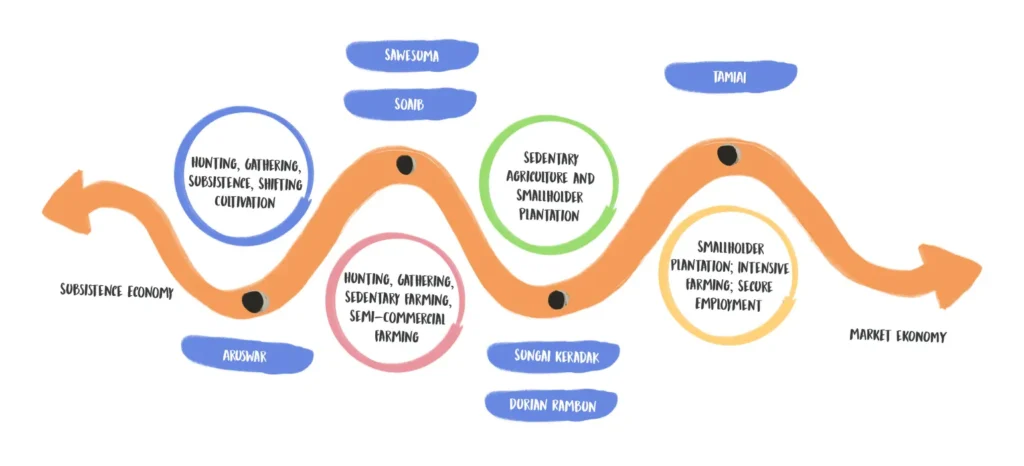
In Indonesia, community resilience is built on the basis of not only diversity of livelihood (as many studies have shown; see e.g., Berkes & Ross 2013), but on the versatility and adaptability of individuals and collectives to shift between one mode of livelihood (i.e., subsistence) and another (market/value-chain based economies). This is partly because the situation in which market economy is the only foundation of livelihood strategies, no matter how diverse they are, would create a lock-in trap which hinders community resilience. This is not the case in Jambi and Papua. Here, the way communities move flexibly from one economic mode (market economy) to another (subsistence), from global value chains to local food systems, is shown to reduce their vulnerability to shocks.
Future outlook
People in the six villages also see their gardens, livestock and especially their vast forests as savings, which are not always clearly valued, but which they believe will always be there in times of uncertainty. Our finding highlights the value of savings, not investment (the latter implies measurable and calculable returns), within the different community groups, manifesting in various forms (from massive forest resources, to cattle, to even unproductive plantation crops). These savings act as a buffer/risk absorber during periods of crises, and they are valued and used as such through specific livelihood strategies.
Social cohesion and leadership.
Leaders play a strong role in maintaining the stability of the society, but also in introducing new ways to adapt to change and being transformative in the process. A strong and balanced interplay between elders and adat leaders, local government officials, progressive youth, and religious leaders can prove to contribute to a more sustainable forest management practice. If even one leader misses a beat, the whole orchestra of leadership loses the rhythm. However, we also need to realize that, particularly in Indonesia, typical patron-client relationships are found across cases (Vicol et al., 2018). Although this may seem negative, the presence of this relationship helps in creating social stability and implementing certain collective values (e.g., forest conservation). What seems to emerge now is a shift towards a more democratic way of governance, led particularly by the younger generational leaders. This is a positive, albeit fragile ground that needs to be taken cautiously.
In addition to the strong leadership, social cohesion is also proven to build into the strength of a resilient community. Gotong royong (collective work), in its many forms, is a feature of rural communities across Indonesia, and yet this gets eroded as more and more capitalistic turn grabs hold. The key is to provide a social space where one can still practice this form of collective action. In both Papua and Jambi, we have found that local economic spaces (market, farm, river) function not only as economic space per se, but also as social spaces where people establish networks and build social capital. These spaces are an integrated part of their local ecosystems as well, in a way that what is exchanged in these spaces are subsistence crops that are part of their ecosystems (betel nut, fish, rice, etc).

People-place relationship.
“The forest is our mother” (hutan itu mama), as what Papuans say about their vast forest ecosystems, resonates well with how the local communities, not only in Papua but also in Jambi, treat their natural home and weave a delicate balance between forest and themselves. Resilience, as we understood, stems from a strong and adaptive people-nature unity. The communities’ dependence on forest ecosystems, through their diverse livelihood strategies, does not devour nature, but instead creates interdependent relationships. In terms of community-based conservation, the community’s sense of dependence on, and belonging to, their local resources builds into their willingness to protect their forests from external pressures.