
Community Logging
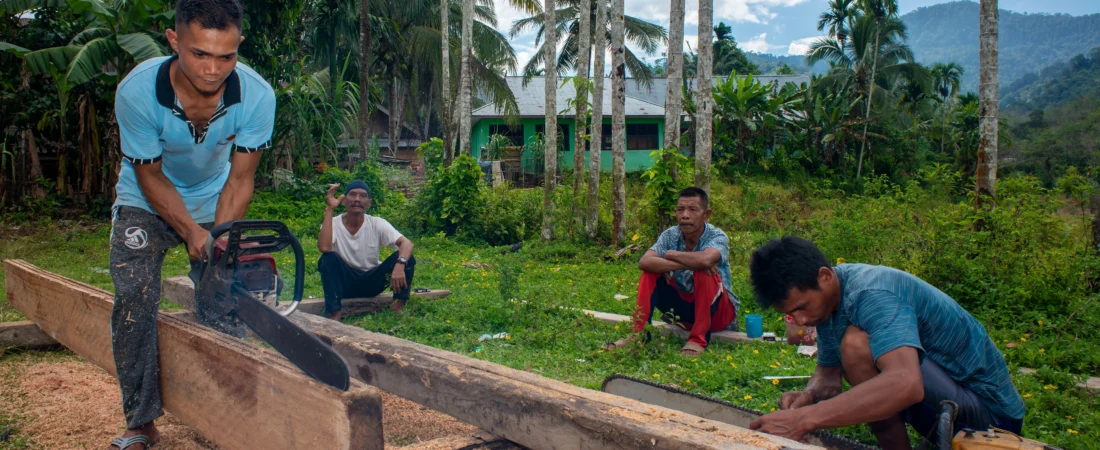
Community logging. In Soaib, we interviewed a particular clan, Kiambe, that makes a living from timber harvesting. Like many other clans, the Kiambe manage a vast forest area through their customary rights. However, while others perhaps see this extensive resource as their saving and ecological buffer, the Kiambe has developed ways to extract timber commercially through their community logging. Ironwood or merbau (Intsia palembanica), one of the most prominent quality timbers from Papua, can be found in abundance in their forest. The Kiambe rented tractors to open logging routes to this forest so that it is accessible by large vehicles such as timber trucks. The community is able to process wood into wooden blocks, which they later sell to the market in Sentani at a price of 3-4 million rupiah per cubic meter. Profits are divided between those of the Kiambe that are involved in the process.
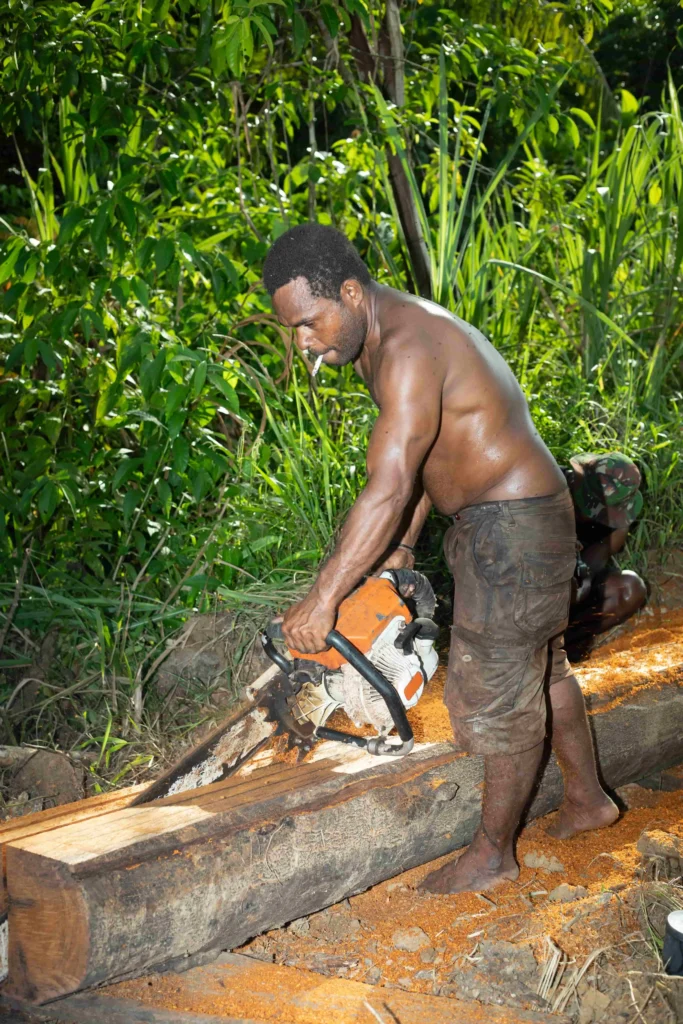
In contrast, people in Sawesuma and Aruswar do not commercially extract timber for commercial purposes, nor do they have the proper equipment to do so. In Aruswar, which is the remotest village to city centers among the three, a large multinational timber concession company manages hundred and thousand hectares of natural forest adjacent to Aruswar village, within which some of the clans own customary rights of the land. The company extracted the timber on a massive scale (with their own port!) and provided a compensation of about 200 to 250 thousand rupiah per cubic to the clans. As the concession area is inaccessible to the local, not all members of the clans can even fathom the sheer scale of this extraction, with only a hint that one clan (consisting of 15 household members) on average receives a total of 300 million rupiah in compensation money every three months, which is an equivalent of 1,200 m3 of timber. Notwithstanding the benefit that the community receives from the company, some of the environmental impacts of this large scale concession are beginning to be felt: passive hunting is no longer effective because a lot of the animals have moved further away, and water quality is deteriorating, both of which the local community have no control over. Compare this with the community logging in Soaib: because the local people manage their own timber production, any changes in the environment (e.g., a decrease in surface water) can be directly felt and thus provide feedback to control their harvest or grow more trees.