
In our study, Social-Ecological Systems (SES) manifest in the closely intertwined relationship between people and forest (or agroforest) ecosystems. Forests in Papua and Jambi cover 78% and 43% of the total area of each province, respectively, with highly diverse, but quite fragmented ecosystem types. The village communities living around forests coexist and manage forest resources sustainably, albeit Jambi and Papua have relatively different patterns of relationships, which we refer to as livelihood strategies.
Livelihood strategies can be defined as a set of activities and resources utilized by individuals or groups to fulfil their needs (Ellis, 2000; Carney, 1998; Scoones, 1998). These livelihood strategies include ways to obtain food, clothing, shelter, health, education, as well as income and access to natural resources. They may vary depending on the social, economic and environmental context in which the community is located (Ellis, 2000). One of the objectives of developing livelihood strategies is to improve community welfare and reduce poverty. They can be considered as an effort to achieve broader development goals, such as improving quality of life and empowering communities (De Haan, 1999; Scoones, 1998).
The availability of resources, such as land, water, livestock and other raw materials, as well as the supporting ecosystems, is by all means critical in influencing the success of livelihood strategies (Ellis, 2000). Sufficient and high-quality resources can help increase productivity and income, but a healthy ecosystem also provides a buffer against various shocks that may compromise their strategies. These resources, in combination with access to capital, knowledge, skills, and markets are considered key elements in the making of sustainable livelihood strategies in Papua and Jambi.
Livelihood strategies in the rural Papua and Jambi can manifest in many different forms; from wild harvesting to intensive agriculture. These strategies can be passed down from one generation to the other, or learned through the community’s interactions with the wider markets, value chains and external stakeholders. These livelihood strategies are built on the specific resources that they have; some are subsistence, some are connected to longer value chains, and some are shown in the form of creative economies. In Papua, for example, natural resources such as coconut, areca nut (Areca cathecu), nibun (Oncosperma tigillarium) and sago (Metroxylon sagu) are an integral part of the community. Through these species, a variety of food and handicrafts are produced. People in Jambi, on the other hand, depend on smallholder plantations with industrial crops such as rubber, coffee and cinnamon. Some also nurture honeybees, grow rice, vegetables, kepayang (Pangium edule) and sugarpalm (Arenga pinnata). Their livelihoods that are in direct contact with forests require a good balance between conservation and livelihoods.
Subsistence farming. In the three villages in Papua, the majority of households rely on subsistence farming as their main source of livelihood. Livelihood strategies in Papuan communities can be divided into two, namely those that are practiced traditionally and often related to subsistence way of living, and those that have just emerged due to the development of village areas, with the latter being less established. The traditional way of living that are still practiced by people in the three villages include subsistence farming, gathering, game hunting, and catching fish or shrimp. As the development of infrastructure in Papua progressed these past decades, including the construction of road access to the nearest city, there are now new forms of living that have emerged due to connections with areas outside the village, such that involves selling vegetables and game meat to the local markets, livestock raising, small grocery store businesses, selling wood products, all the way to more creative economies such as ecotourism, cultural handicrafts, and sago-based food products.
Papuans in these three villages practice shifting cultivation with an average cultivated land area of about 250 m2 or less. The locals themselves do not recognize the concept of metrics, so asking “how large is your farmland?” seems confusing. The activity of opening and working on a new patch of land usually involves all members of one or more families who have access to a particular hamlet or forest area. The process starts from the land clearing stage, in which women and children clear shrubs, bushes and ropes around large trunks; then, large trees are cut down by adult men. Trees that have been cut down are left to dry, then burned. The local community has their way of controlling the bushfire in such a way that it does not spread to the surrounding forest: the burned trees, shrubs and dry leaves are gathered separately at a distance of approximately three to five meters from another, in a way that resembles a fire breaker. A day after the burning, the wood scattered in the garden is collected in a particular place. After the land is considered clean and suitable for planting, the area is then planted with seeds using a tugal.
In the three villages in Papua, the types of crops grown are relatively similar. Farmers apply a mixed garden system, which is planting various types of plants in one area. Annual crops can be harvested in a matter of months, while perennial crops require a multi-year period on average. Traditional annual vegetables include the likes of waxy vegetables, gedi, mustard greens, local spinach and others. In addition, people also grow tubers such as taro, yams, cassava, and betatas (sweet potato). Tree crops also vary, from the more traditional and native types such as coconut, matoa, breadfruit, gomo, banana, areca nut, mango and bay tree, to commercial and modern tree crops such as jackfruit, orange, guava, coffee, cocoa, durian, snakefruit and rambutan. These types of crops can also be found in the district market (Sawoi Market) for Soaib, Bonggo Market for Sawesuma, and the Sarmi Regency Capital Market for Aruswar.
In Jambi, farming is more commonly practiced and on a relatively larger scale, although one might still consider it as a smallholder activity. Small-scale shifting cultivation is still the dominant farming pattern in the three villages of Durian Rambun, Sungai Keradak, and Tamiai. Based on a welfare survey conducted by FFI in 2020, over 50% of the households manage 1-2 ha of farmland, while 37% manage more than two hectares of land and only 5% manage more than five hectares. The remaining 9% manage less than one hectare and 16% have no land at all. The latter work with a profit-sharing system (under the 1 to 3 division, which means that one part of the yield is given to the landlord and two parts are for the farmer), or are hired as farm workers.
Land owned by the village members is generally not certified, with the proof of land ownership being only in the form of unwritten knowledge passed between family members. Rivers, bunds, and certain plants such as areca nuts are usually used by the community as land boundary markers. Most of the smallholder plantations are located within the production forests that are managed by the Forest Management Units (FMUs) in each district. Legally, the community has obtained the right to manage the land for 35 years through a social forestry scheme with a permit area of 4,484 ha each for Durian Rambun, 3,241 ha for Sungai Keradak, and 850 ha for Tamiai. In Durian Rambun and Sungai Keradak villages, the village forest scheme was developed to ensure and secure forest areas from company concessions while supporting community livelihoods, while in Tamiai the Community Forest scheme was chosen to support the utilization of forest areas for agricultural activities by farmer groups in the production forest area adjacent to the National Park.
Agricultural land is generally planted with various types of crops (multi-culture) such as coffee, rubber, and cinnamon. In between these medium and long-term crops, farmers usually grow patchouli, red ginger, and vegetables that can be harvested within a few months. Vegetables are planted by the community as a short-term strategy to meet daily needs before the coffee plant as a medium-term crop produces fruit. When cinnamon plants have started to grow tall and cover coffee plants, usually at the age of four years, coffee productivity will decline and yields will be less. Farmers usually thin out the coffee plants and leave only cinnamon plants in the garden. After that, farmers will open another garden with the same cycle while waiting for the cinnamon plants in the previous garden to be harvested. In addition to growing coffee and cinnamon, farmers also grow fruits such as avocado, durian, jackfruit, petai and jengkol. Especially in Durian Rambun and Sungai Keradak, rubber plantations still exist and are cultivated by only a few farmers. Rubber plantations have begun to be abandoned by the community due to price fluctuations and increasing agricultural costs.
Rice is grown in all three villages in Jambi as an important staple food. In Durian Rambun, rice is grown on dry land (padi huma) in a more traditional way, whereas the practices transition in Sungai Keradak with rain-fed paddy fields and in Tamiai with a more sophisticated irrigation system. Dry-land rice is planted on different land each year through land clearing. This shifting practice is essential because farmers in Durian Rambun and Sungai Keradak do not use any chemical inputs and thus rely on soil nutrients provided from the burning and land clearing. This practice is enough to provide each household with sufficient rice stock for the whole year.
Growing rice in the three villages in Jambi serves not only as a household livelihood strategy, but also as part of the collective work built by the community and passed down for generations. In Sungai Keradak, rice cultivation is done six months prior to the Muslim’s holy month of Ramadhan, where the village officials, in deliberation with the community and religious leaders, determine the starting period of cultivation. This system of production is known as Turun Menaun, and is meant to achieve enough rice stock by the time of Ramadhan, whilst ensuring that the community members can focus on their religious activities during the holy month. In addition, having simultaneous rice growing is a strategy to reduce the risk of crop failure due to pest outbreaks.
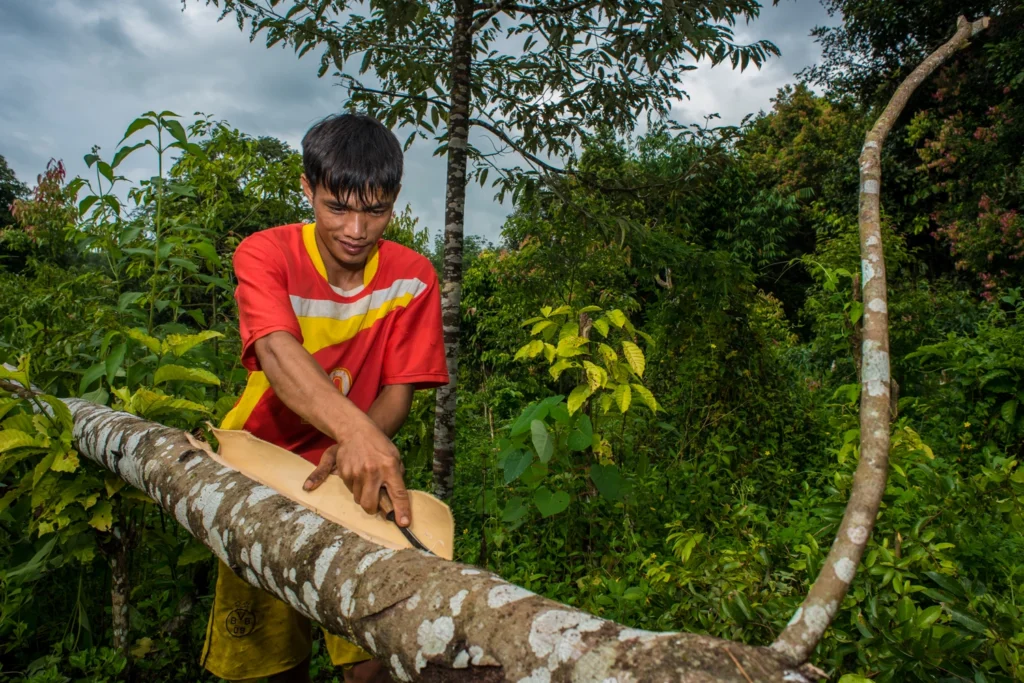
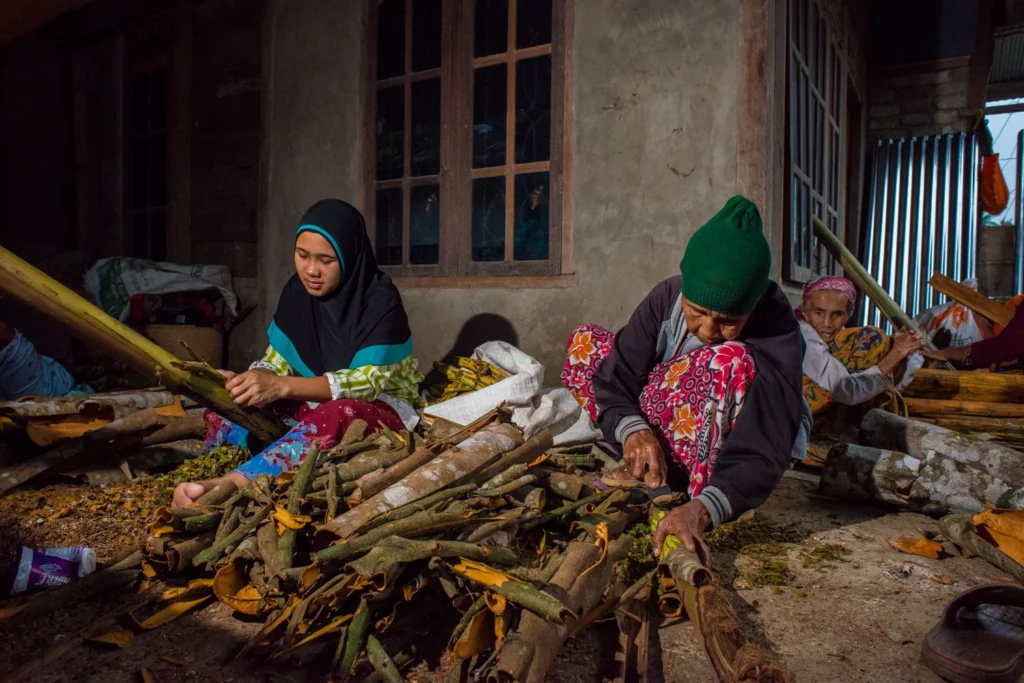
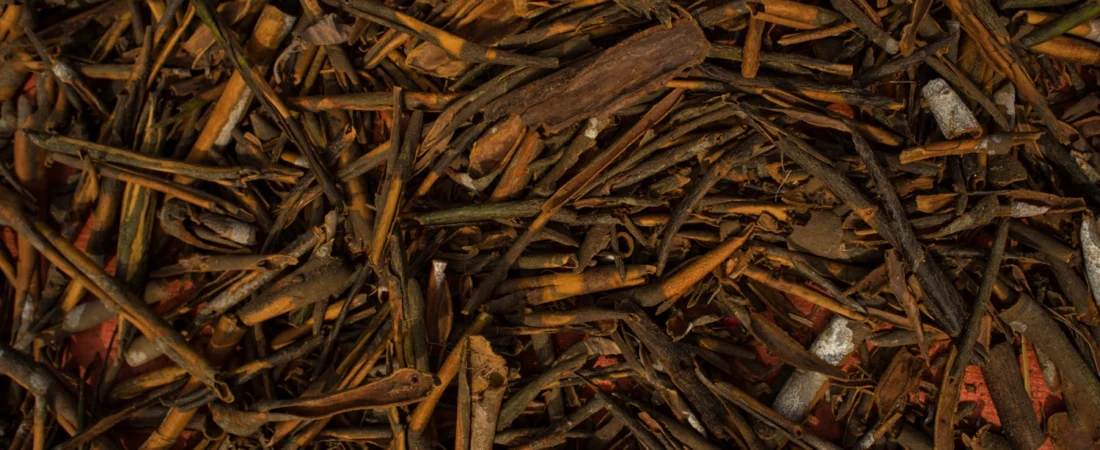
Unlike coffee and rubber, cinnamon harvesting is mainly done by male farmers in the village, as the work of harvesting is quite heavy and time-consuming. During the harvest, the cinnamon sticks are cut down and the bark peeled off. The skin will then be scraped to remove the outer layer of the stem and then dried in the sun, after which the roll-shaped skin will be sold to collectors. Cinnamon harvesting is paid with a wage system of Rp.2000/kg of clean/chipped yield.These daily farm workers work in groups of 4-10 people at a time.
Cinnamon sold to collectors is divided into several categories. In Tamiai, they are grouped into six different quality grades, namely KC, KB, KA, KS, KF and KM with a purchase price per kilogram from farmers at IDR 20,000, 40,000, 47,000, 52,000, 58,000, and IDR 65,000, respectively. The separation of these categories is based on the amount of skin, water and oil content. After being in the hands of collectors, the sweet peels will then be sorted again by collectors to be dried again and sold to large collectors or companies in Padang.